India Pakistan Fighter Jets: A Comprehensive Comparison
- The Enduring Rivalry in the Skies
- Fleet Composition and Numbers: A Quantitative Look
- Key Players: Rafale vs. JF-17 Thunder
- The F-16 and Tejas: Different Philosophies
- Modernization Efforts and Future Plans
- Electronic Warfare and Air Defense Systems
- The Balakot Incident: A Case Study
- Beyond the Hardware: Training and Strategy
- India Pakistan Fighter Jets: What the Future Holds
India Pakistan fighter jets are a subject of intense scrutiny, reflecting the long-standing strategic rivalry between the two South Asian neighbors. Having followed defense developments in the region for years, I’ve seen firsthand how both nations continuously strive to modernize their air forces. This ongoing effort isn’t just about acquiring the latest aircraft; it’s a complex interplay of strategic needs, technological advancements, and economic realities. The capabilities of India Pakistan fighter jets are a critical factor in the regional power balance.
The skies above India and Pakistan have, at times, turned into a battleground, underscoring the significance of their respective air forces. Understanding the strengths and weaknesses of their fighter fleets offers a glimpse into the broader defense postures of these nuclear-armed nations. It’s a dynamic situation, with both sides constantly evaluating and upgrading their aerial assets.
Fleet Composition and Numbers: A Quantitative Look
When we talk about India Pakistan fighter jets, the sheer numbers often come up first. According to FlightGlobal’s World Air Forces directory for 2025, India commands a significantly larger fleet with 616 combat aircraft, while Pakistan has a fleet of 387 jets. India’s overall military aircraft count is also higher, with 2,229 military aircraft compared to Pakistan’s 1,399, as per a May 2025 report. However, as any defense analyst will tell you, it’s not just about who has more planes; the type and quality of these aircraft, along with pilot training and strategic deployment, are equally crucial.
The Indian Air Force (IAF) operates a diverse mix of aircraft from various international suppliers, including Russia, France, and the UK, alongside indigenously developed platforms. The Pakistan Air Force (PAF), on the other hand, has historically relied heavily on the United States and China for its aircraft. This difference in sourcing impacts everything from maintenance and upgrades to interoperability and strategic alignment. My experience suggests that managing such a diverse fleet, like India’s, can present unique logistical challenges, while a more streamlined inventory, like Pakistan’s with its focus on Chinese and US platforms, might offer certain advantages in terms of maintenance and training.
Key Players: Rafale vs. JF-17 Thunder
At the cutting edge of the India Pakistan fighter jets comparison are the French-made Dassault Rafale for India and the Sino-Pakistani jointly developed JF-17 Thunder for Pakistan. India considers the Rafale its “highest profile asset,” having inducted 36 of these 4.5-generation multirole fighters. The Rafale is known for its advanced avionics, including the Thales RBE2 AESA radar, integrated sensor fusion, and the sophisticated SPECTRA electronic warfare suite. It carries a range of potent weapons, including Meteor beyond-visual-range air-to-air missiles and SCALP cruise missiles.
Pakistan’s JF-17 Thunder, particularly the Block III variant, is a 4th-generation lightweight, single-engine multirole fighter. While generally considered less advanced than the Rafale, the JF-17 Block III is equipped with a KLJ-7A AESA radar and can carry modern BVR missiles like the PL-15. Pakistan has a significant number of JF-17s, with reports suggesting a fleet of 156 jets as of late 2024. The JF-17 offers a cost-effective solution and is a symbol of the relationship between Islamabad and Beijing. When comparing the JF-17 Thunder and Dassault Rafale, the Rafale generally stands out as the superior platform in terms of technological sophistication and overall combat capabilities, though the JF-17 offers advantages in affordability and ease of maintenance for certain air forces.
It’s interesting to note the difference in design philosophies. The Rafale is a twin-engine, heavier aircraft designed for high-end combat missions across all combat domains, while the JF-17 is a lighter, single-engine fighter. This impacts factors like payload capacity, range, and maneuverability. The Rafale has a higher maximum takeoff weight and more external hardpoints for carrying weapons compared to the JF-17.
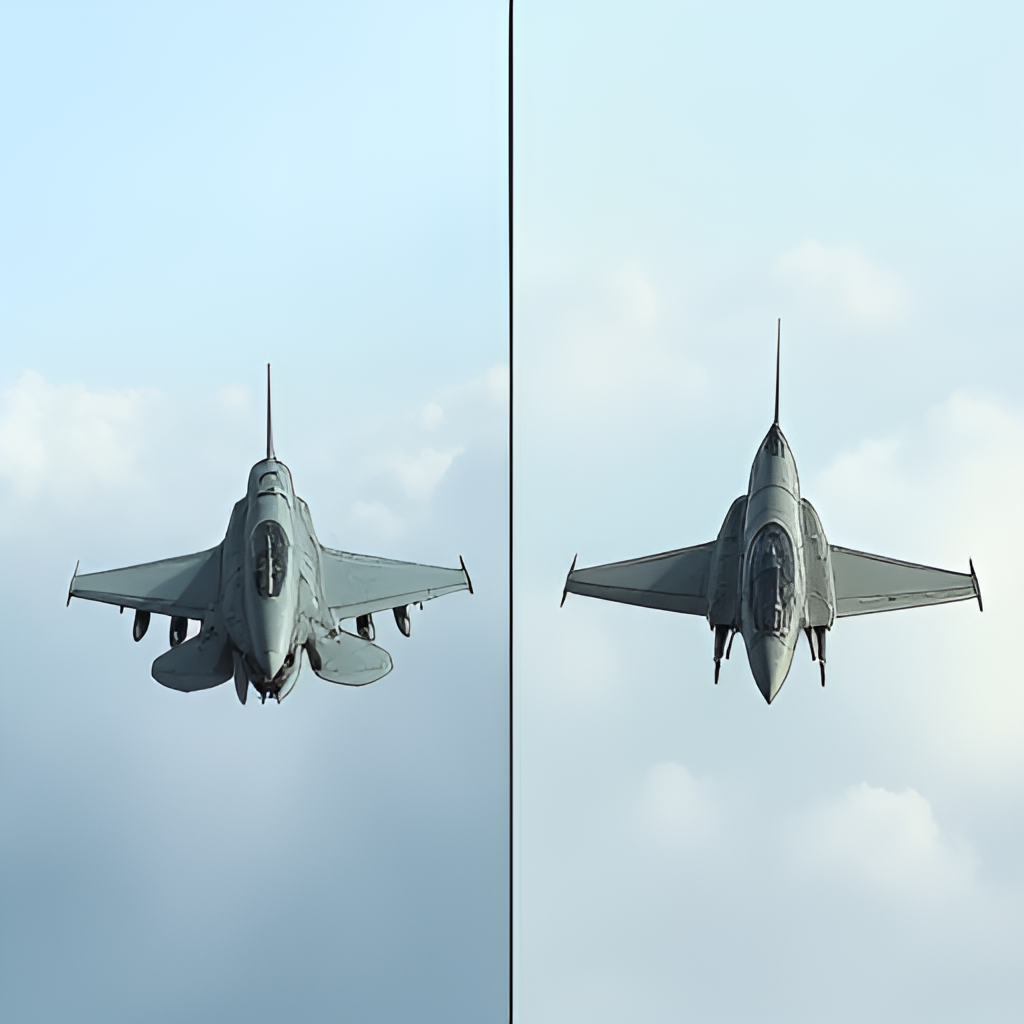
This image is a fictional image generated by GlobalTrendHub.
The F-16 and Tejas Comparison
Beyond the Rafale and JF-17, both air forces operate other significant fighter types. Pakistan has a considerable fleet of US-made F-16 Fighting Falcons. The F-16 is a widely proven multirole fighter known for its air dominance capabilities, especially in dogfighting scenarios. Pakistan’s F-16s have been subject to “end-user agreements” with the US, which can limit their operational deployment.
India’s indigenous Light Combat Aircraft (LCA) Tejas is another key component of the IAF’s modernization efforts. The Tejas, a lightweight multirole fighter, is gradually being inducted into the IAF fleet. While the Tejas Mk1 has been compared to earlier blocks of the JF-17, with some analyses suggesting the Tejas has better survivability due to a lower radar cross-section (RCS), the F-16 generally outperforms the Tejas in terms of engine thrust, speed, and operational range. The F-16’s larger size and weight allow for higher payloads and extended missions compared to the lighter Tejas.
Modernization Efforts and Future Plans
Both India and Pakistan are actively pursuing modernization programs to enhance their air force capabilities. India aims to increase its squadron strength and is looking to acquire 114 new medium multirole fighter jets through the MRFA program, with contenders including the Rafale, Eurofighter Typhoon, F-15EX, and F-21. India is also developing its own fifth-generation stealth fighter, the Advanced Medium Combat Aircraft (AMCA).
Pakistan, too, has initiated a significant modernization drive, particularly following the February 2019 skirmish with India. The PAF is phasing out older aircraft like the F-7Ps and Mirage IIIs and replacing them with more modern platforms like the Chinese J-10CE and JF-17C. Pakistan has also unveiled the PFX (Pakistan Fighter Experimental) program, an upgrade to the JF-17 with stealth features, and is in the process of acquiring Chinese J-35 fifth-generation fighter jets.
Electronic Warfare and Air Defense Systems
Modern aerial combat isn’t just about fighter jets; electronic warfare (EW) and air defense systems play a crucial role. The Rafale’s SPECTRA EW suite is considered among the most advanced globally. Pakistan has also been investing in EW/ESM systems as part of its modernization.
In terms of air defense, India has a multi-layered system, including the S-400. Pakistan operates systems like the Chinese HQ-9 and HQ-16. Recent reports suggest that Indian strikes have degraded some of Pakistan’s early warning capabilities, highlighting potential vulnerabilities in their air defense network.
The Balakot Incident: A Case Study
The aerial engagements in February 2019 following the Pulwama attack offer a real-world glimpse into how India Pakistan fighter jets might perform in a conflict scenario. India used Mirage 2000 fighter jets armed with Spice 2000 precision-guided bombs for the Balakot airstrike. Pakistan responded with Operation Swift Retort, involving their F-16s, JF-17s, and Mirage III/Vs. The incident saw claims and counter-claims regarding aircraft shot down. While Pakistan claimed to have shot down Indian jets, including a Rafale (though this claim is disputed), India acknowledged the loss of a MiG-21. My personal takeaway from this event was a stark reminder that while technology is vital, the unpredictable nature of aerial combat and the human element significantly influence outcomes.
This image is a fictional image generated by GlobalTrendHub.
Beyond the Hardware: Training and Strategy
Beyond the technical specifications of India Pakistan fighter jets lies the equally important aspect of pilot training and strategic doctrine. Both air forces regularly conduct exercises to hone their skills. Some analyses suggest that Pakistan, despite a smaller fleet, benefits from coherent planning, interoperable technologies, and a responsive command structure. India, with its diverse inventory, faces the challenge of integrating varied systems.
The strategic objectives also differ. India is focused on countering threats from both Pakistan and China, which influences its procurement of a range of aircraft for different roles. Pakistan’s strategy is primarily centered on deterrence against India. These strategic considerations shape how each air force structures its training and deploys its assets.
India Pakistan Fighter Jets: What the Future Holds
The comparison of India Pakistan fighter jets reveals a complex and evolving landscape. India possesses a numerical advantage and is investing heavily in advanced platforms like the Rafale and future indigenous fifth-generation fighters. Pakistan, while having a smaller fleet, is modernizing with Chinese aircraft and enhancing its electronic warfare and air defense capabilities. The 2019 Balakot incident highlighted the intensity of potential aerial confrontations and the importance of both advanced technology and effective strategy. As both nations continue to acquire and develop new aircraft, the balance of power in the skies remains a critical aspect of regional security. My experience observing these developments tells me that while the hardware is important, the human factor—training, tactics, and strategic decision-making—will ultimately determine the effectiveness of India Pakistan fighter jets in any future scenario.